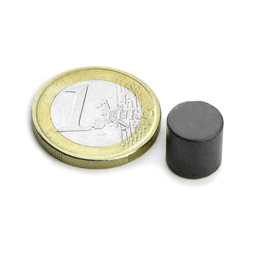
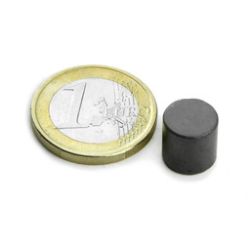
Magnet Shape: Disc / Disk / Round
Material: Hard Ferrite (Ceramic)
Coating: No Coating
Grade(Chinese Stardard): Y30
Detailed magnetic properties data:
Residual Magnetic Flux Density (Br): 3.2-3.8 KGs (mT): 320-380 mT
Intrinsic Coercivity Force (Hcj): 1.70-2.38 KOe 135-190 KA/m
Coercivity Force (Hcb): 1.76-2.45 KOe 280-320 KA/m
Energy Density (BH)max: 2.0-2.8 MGOe 18.0-22.0 KJ/m³
Operating Temperature: -40 °C to +250 °C
Magnetisation Direction: Axial / Radially magnetized
Size (Can be customized according to customer drawings):
Outside Diameter(D): 10 mm
Thickness(T): 10 mm
Tolerance: +/-2% mm
Delivery time 7-25 days
Measurements
PRICE
On the one hand, ferrite material only costs a fraction of the NdFeB material. On the other hand, a neodymium magnet has an adhesive force that is about 8 to 10 times higher than that of a comparable ferrite magnet. If you calculate the cost per kg of adhesive force, ferrite magnets are about 2 to 3 times cheaper than neodymium magnets. This is especially true for block or ring magnets and for larger quantities. (With disc magnets the price per kg of adhesive force is comparable.)
The cost advantage is only then relevant, however, if weight and size do not matter, because the ferrite magnet is much heavier and larger than a neodymium magnets with the same adhesive force.
Price stability
Ferrite magnets are less subject to price fluctuations than neodymium magnets because their production does not require rare earth metals.
Temperature resistance
Ferrite magnets can be used at temperatures between -40 °C and 250 °C, while most neodymium magnets lose their magnetisation permanently at a temperature of 80 °C. However, temperatures under -40 °C are no problem for neodymium magnets.