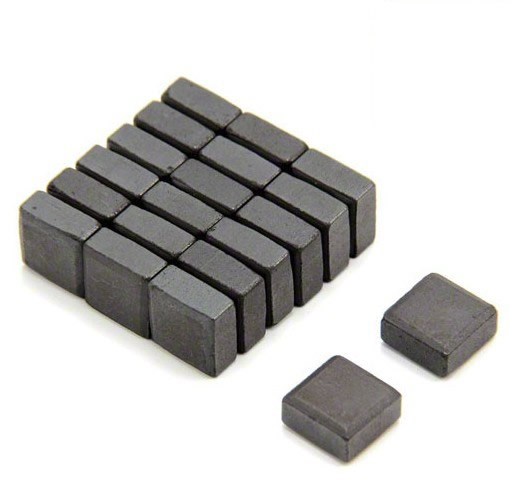
Item No.: C12-Ceramic-1
Magnet Shape: block / Tube
Material: Hard Ferrite (Ceramic)
Composite: Fe2O3 (BaCo3 or SrO3), Fe3O4 (SrCo3, SiO2)
Type: anisotropic or isotropic
Style: Sintered Permanent Magnet
Grade(USA Stardard): C12
Detailed magnetic properties data:
Residual Magnetic Flux Density (Br): 4.00 KGs (mT): 400 mT
Intrinsic Coercivity Force (Hcj): 3.64 KOe 290 KA/m
Coercivity Force (Hcb): 3.99 KOe 318 KA/m
Energy Density (BH)max: 4.02 MGOe 32.0 KJ/m³
Operating Temperature: -40 °C to +250 °C
Magnetisation Direction: Axial / Radially magnetized
Size Can be customized according to customer drawings:
Tolerance: +/-2% mm
Delivery time 7-25 days
Ceramic Magnets
General Information
Ceramic (Ferrite) magnets are sintered permanent magnets composed of Barium or Strontium Ferrite. This class of magnets, aside from good resistance to demagnetization, has the popular advantage of low cost.
Ferrite magnets are very hard and brittle, and require specialized machining techniques. Moreover, they should be machined in an unmagnetized state. We are equipped to machine these materials to specifications.
Anisotropic grades are oriented in the manufacturing direction, and must be magnetized in the direction of orientation. Isotropic grades are not oriented and can be magnetized in any direction, although some degree of greater magnetic strength will be found in the pressing dimension, usually the shortest dimension.
Due to their low cost, Ferrite magnets enjoy a very wide range of applications, from motors and loudspeakers to toys and crafts, and are the most widely used permanent magnets today.
Manufacturing Methods
Pressing and Sintering
Pressing and sintering involves pressing very fine ferrite powder in a die, and then sintering this pressed magnet. All fully dense Ferrite magnets are produced this way. Ferrite magnets can be wet pressed or dry pressed. Wet pressing yields better magnetic properties, but poorer physical tolerances. Generally, the powder is dry for grade 1 or 5 materials, and wet for grade 8 and higher materials. Sintering involves subjecting the material to high temperatures to fuse the pressed powder together, thus creating a solid material. Magnets produced through this process usually need to have some finish machining, otherwise surface finishes and tolerances are not acceptable. Some manufacturers extrude instead of press wet powder slurry and then sinter the material. This is sometimes done for arc segment shapes, where the arc cross-section is extruded in long lengths, sintered, and then cut to length.