-Produce (sintering) by powder metallurgical method
-Chemical composition of Ba/SrO.6 Fe2O3
-Relatively brittle & hard
-Good resistance to demagnetization
-Excellent corrosion resistance
-Raw material is readily available & low in cost
-Good temperature stability
-Most widely used permanent magnets.
Original Manufacturer:HangSeng Magnetech / HSMAG / Ferritei
Solution:Customized you required ferrite material, grade, size, shape, grade, pull force and woking temperature
Origin:Ningbo, Zhejiang, China
Supply Ability:500000 pcs/day
Certification:SGS,TUV,ISO9001,ROHS,TS16949
Applications:motors, magnetic couplings, for sensing, loudspeakers, holding-magnet systems, crafts, magnetic therapy, novelties, and toys.
Detailed Product Description:
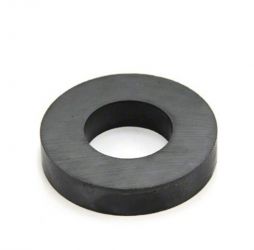
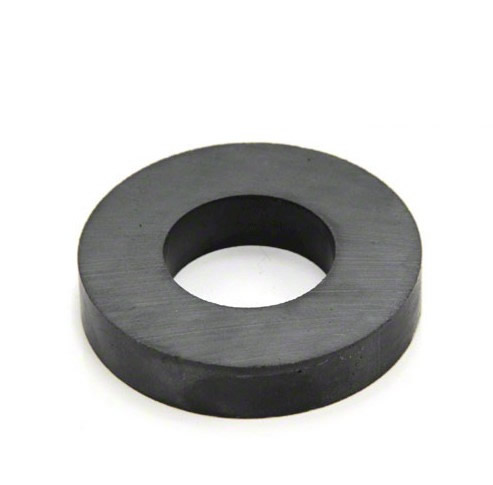
Item No.: C12-Ceramic-3 Magnet Shape: Ring / Tube Material: Hard Ferrite (Ceramic) Composite: Fe2O3 (BaCo3 or SrO3), Fe3O4 (SrCo3, SiO2) Type: anisotropic or isotropic Style: Sintered Permanent Magnet Grade(USA Stardard): C12 Detailed magnetic properties data: Residual Magnetic Flux Density (Br): 4.00 KGs (mT): 400 mT Intrinsic Coercivity Force (Hcj): 3.64 KOe 290 KA/m Coercivity Force (Hcb): 3.99 KOe 318 KA/m Energy Density (BH)max: 4.02 MGOe 32.0 KJ/m³ Operating Temperature: -40 °C to +250 °C Magnetisation Direction: Axial / Radially magnetized Size Can be customized according to customer drawings: Tolerance: +/-2% mm Delivery time 7-25 days Hard Ferrite (Ceramic) Magnets Ceramic Magnets Hard Ferrite magnets are commonly known as Ceramic magnets due to the process used to produce them. Ferrite magnets are manufactured mainly of strontium or barium ferrites and iron oxide. Hard Ferrite (Ceramic) magnets are produced as Isotropic and Anisotropic types. Isotropic type magnets are produced without orientation and can be magnetized in any direction. On the other hand, Anisotropic magnets are exposed to an electromagnetic field during their process to achieve higher magnetic energy and properties. This is done by pressing dry powders or slurry into a desired die cavity with or without orientation. After the compaction into the dies the parts are exposed to a high temperature, a process known as sintering. This process allows them to hold the shape of the part and gives them mechanical and magnetic strength, and produces hard brittle parts. Because of their physical strength they should not be used as a structural part in any assembly. The grinding process using diamond grinding wheels allows for close dimensional tolerances. Ferrite (Ceramic) magnets have good resistance to demagnetization and with their high Curie temperature they have excellent high working temperatures and most of all they have excellent resistance to corrosion. Ferrite (Ceramic) magnets are excellent choices for many applications due to their economical low price and abundance of raw materials and they do not fluctuate much in price.They are the most widely used magnets in a wide range of applications. Ferrite (Ceramic) magnets come in a variety of shapes; round, square, rectangular, arc segments, triangle, rings and special shapes.